

The Indian Railways (IR) is like a giant, perfectly coordinated machine. While you see trains moving, the real work happens behind the scenes, thanks to smart engineering that builds on local Indian innovation (the ‘Make in India’ idea).
The whole railway system can be broken down into three simple parts: the base they run on, the trains themselves, and the smart technology that keeps them safe.
1. The Permanent Way: The Strong Foundation
This is the term for the railway track—the permanent road the trains travel on. It has to be incredibly strong to handle millions of tonnes of weight every day.
The Four Layers of the Track
A train track isn’t just metal on the ground; it’s a carefully layered foundation:
- Rails: These are the long, smooth steel bars that the wheels roll on. Indian tracks use heavy, flat-bottomed rails that are bolted firmly down to prevent tilting.
- Sleepers (Ties): These are the thick concrete blocks that sit across the track. Their job is to hold the rails at the exact correct distance apart and spread the train’s huge weight downward.
- Ballast: This is the layer of rough, crushed stones beneath the sleepers. The ballast holds the sleepers in place, stops the wooden/concrete blocks from shifting, and allows water to drain away, keeping the ground stable.
- Sub-Grade: This is the smoothed-out earth underneath the ballast—the final natural foundation layer.
Wide Track Standard
India mostly uses the Broad Gauge (1,676 mm), which means the tracks are wider apart than in many other countries. This wide base is a key engineering decision because it allows the trains to be heavier and more stable, letting them run long distances at higher speeds safely.
2. Motive Power: The Engines and Coaches
This covers the technology that moves the trains (the locomotives) and the carriages people sit in (the rolling stock).
The Power Shift to Electricity
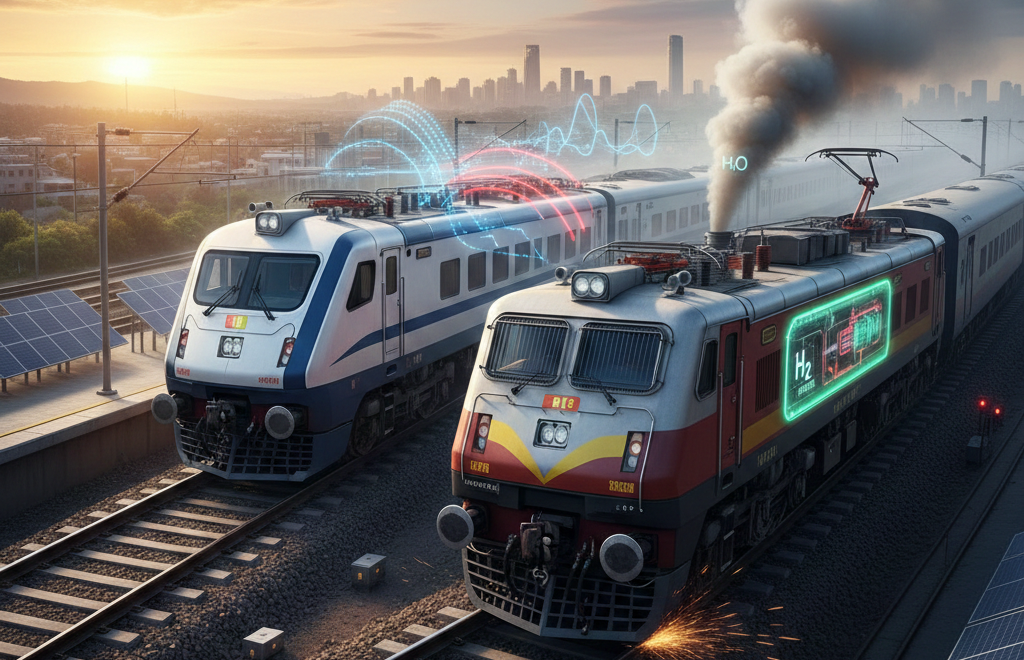
Indian Railways has largely moved away from polluting diesel engines toward clean, electric locomotives. This is better for the environment and much cheaper to run. India now makes its own high-powered electric engines, featuring advanced 3-Phase drive technology. Think of this as a very efficient electric motor system that can even put energy back into the power lines when the train slows down (like regenerative braking in an electric car).
India’s New Super-Trains
The best example of Indian ingenuity is the Vande Bharat Express. These are not regular trains pulled by a separate engine; they are modern, self-propelled trainsets.
- Fast Braking: Because motors are integrated into the coaches (Distributed Power), the train can speed up and slow down much quicker than old trains.
- Safety First Coaches: The coaches use a modern design that prevents them from piling up or climbing on top of each other during a collision, making them much safer than older models.
The Future is Green: Hydrogen
In a major engineering step, Indian Railways is developing a powerful 1,200 HP Hydrogen Engine. This aims to replace the remaining diesel trains with engines that run purely on hydrogen, making the network completely carbon-free and placing India at the forefront of green rail technology globally.
3. Kavach: India’s Digital Safety Shield
“Kavach” means “Armour” in Hindi, and that is exactly what this indigenous safety system is: a digital armour for the trains. It uses smart software and electronics developed in India and meets the world’s highest safety standards (SIL-4).
How Kavach Protects Trains
Kavach acts like a co-pilot, watching the track and the signals ahead:
- Constant Check: Electronic devices in the engine communicate non-stop with sensors and stations along the track using radio waves.
- Knows its Location: Special tags (like digital barcodes) placed on the sleepers tell the train its exact location, direction, and speed limit.
- Prevents Crashes: If a driver accidentally ignores a stop signal, or if two Kavach-equipped trains are heading towards each other on the same track, the system automatically takes over and applies the brakes immediately. This is its most vital function.
- Assists Drivers: It helps drivers stay within speed limits and even shows them the status of signals inside the cabin during heavy fog, where visibility is zero.
Indian engineering continues to push the railway system forward, ensuring that the movement of goods and billions of people is driven by indigenous technology that prioritizes safety and efficiency.







Leave a Reply