

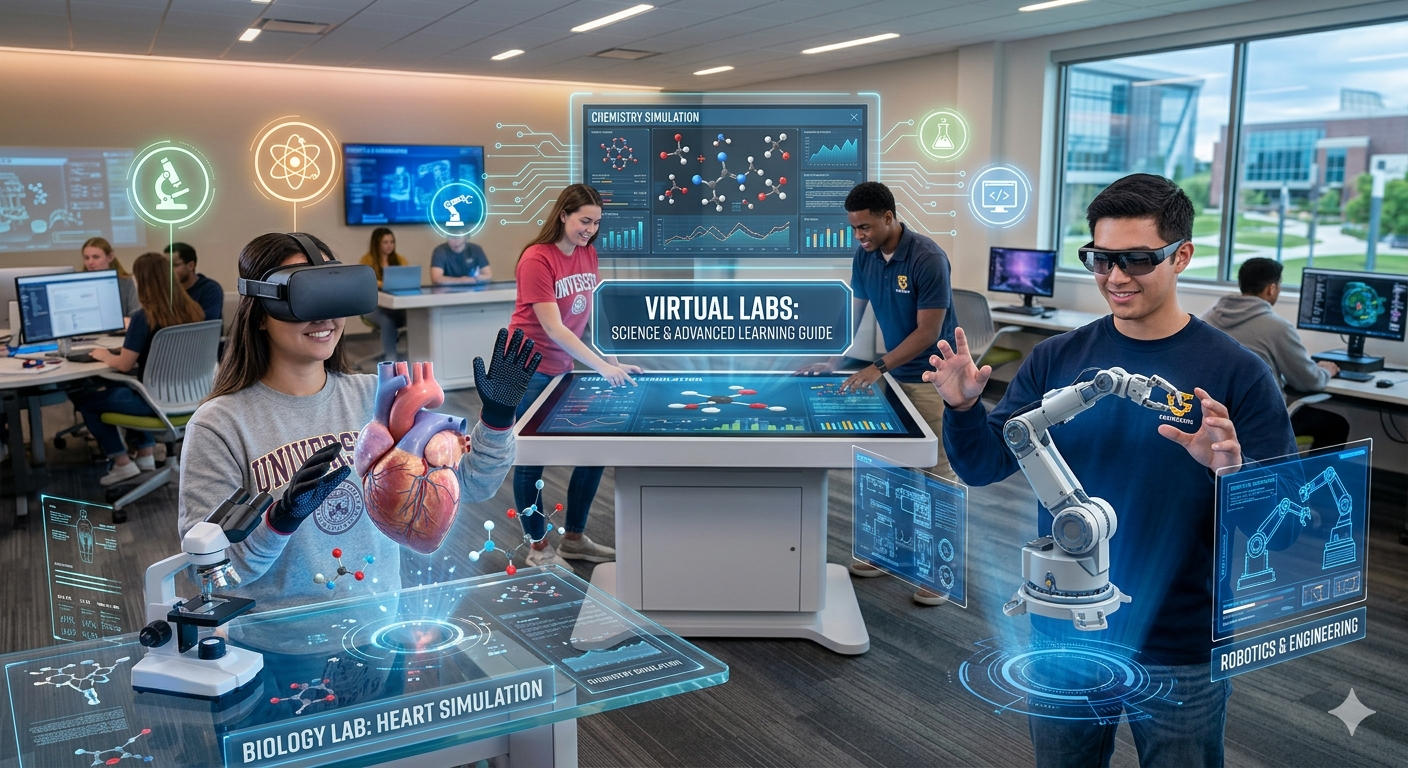
Virtual Labs is a landmark initiative by the Ministry of Education (MoE) under the National Mission on Education through ICT (NMEICT). It provides remote-access to laboratories in various disciplines of Science and Engineering. These Virtual Labs cater to students at the undergraduate, post-graduate, and research levels.
The primary goal is to provide high-quality, expensive equipment and laboratory experiences to students who do not have access to such resources in their physical institutions.
1. Key Features of Virtual Labs
- No Physical Constraints: Perform experiments 24/7 from any location with an internet connection.
- Cost-Free Access: Access to sophisticated lab equipment that would otherwise be very expensive to maintain.
- Safe Learning Environment: Students can perform hazardous chemical or electrical experiments without any risk of physical injury.
- Interactive Simulations: Uses high-end animations and video-based demonstrations to explain scientific laws.
- Self-Evaluation: Each lab includes pre-test and post-test quizzes to assess the learner’s understanding.
2. Participating Institutes
The content is developed by India’s premier institutes, ensuring world-class academic standards:
- IIT Delhi
- IIT Bombay
- IIT Kanpur
- IIT Kharagpur
- IIIT Hyderabad
- Amrita Vishwa Vidyapeetham
3. Step-by-Step Guide to Use Virtual Labs
Follow these steps to conduct a scientific experiment online:
Step 1: Access the Portal
Visit the official website at vlab.co.in.
Step 2: Select Your Broad Area
On the homepage, you will see categories such as:
- Electronics & Communications
- Computer Science & Engineering
- Chemical Sciences
- Physical Sciences
- Mechanical Engineering
Step 3: Choose a Specific Lab and Experiment
- Click on your chosen field (e.g., Physical Sciences).
- Select a lab (e.g., Heat & Thermodynamics Virtual Lab).
- A list of experiments will appear. Select the one you wish to perform (e.g., Newton’s Law of Cooling).
Step 4: Follow the Learning Path
Each experiment is divided into sections:
- Theory: Understand the scientific principle behind the experiment.
- Procedure: Read the step-by-step instructions on how to perform the simulation.
- Simulation: This is the actual interactive lab. Move sliders, change variables, and click “Start” to see the results.
- Observations: Record the data generated by the simulation.
Step 5: Self-Assessment
Complete the Quiz section to verify your results and check if you have understood the concept correctly.
4. Advanced Learning Opportunities
Virtual Labs is not just for basic science; it includes advanced modules for:
- Robotics: Programming and simulating robot movements.
- Nanotechnology: Visualizing molecular structures.
- Biotechnology: Simulating DNA extraction and sequencing.
5. Integration with NEP 2020
In line with the National Education Policy 2020, Virtual Labs promotes Experiential Learning. It encourages students to move away from rote memorization and towards a “discovery-based” approach where they can fail and retry experiments as many times as they want without wasting physical chemicals or components.
Summary: Virtual Labs democratizes science education in India. By following these steps, any student with a basic computer can access the same level of experimental training as a student at an IIT.






Leave a Reply